By Paul Chen
Zortrax, one of the first Polish 3D printer startup announced that they will be selling their 3D printers on-site in an outlet called Z-Store, starting in October. It will be the first time in Poland that 3D printers will be sold on-site on the Polish market and one of the first in Europe. Zortrax is cooperating with the 3D printing community organizer, Materialination in Krakow who will act as a retail outlet of printers and will also act as a showroom. This point of sales will not only be a place where you can get printers, filaments, and parts, it will also act as a education center and exhibition center showcasing the possibilities of 3D printing. Workshops will be offered as well as possibility to do some rapid prototyping of your ideas. This news is coming on the heels of Makerbot announcing that they will be selling their 3D printers in Home Depot.
These desktop printers will include the ones that employ LPD technology. A third printer will be UV cured smooth polymer printers which offer a higher precision printing. Zortrax has been working with ex-Mazda and Bugatti designer Pawel Czyzewski and recently hired industrial designer Karim Rashid who was featured in Time magazine.
Zortrax is growing very rapidly and believes that it will be able to make 3D printing equipment modern, functional, and sexy. Currently, a Zortrax retails for under $2,700 and filaments start at under $36. More information can be found here.
Thank you for reading another one of my posts done just for you! If you liked what you read please share it by using one of the buttons up top and check out other posts in this blog. I don’t want you to miss out on future posts so please follow me on Twitter @Eurodude23. If you haven’t done it already, please like my fan page by clicking here! See you next time!
Saturday, September 13, 2014
Wednesday, September 10, 2014
Ecois.me wants to help you cut down on energy costs by making your home smarter
By Paul Chen
In 2014, one cannot go anywhere without their cell phones or gadgets. The appetite for energy is so fierce that people go to wars over it. It has been and will continue to be a problem that we all must grapple with as more and more devices and economies are based on the internet, the cloud, and things running on moving electrons. An Ukrainian startup based in Krakow, Ecois.me is hoping to make energy consumption more economical for your home.
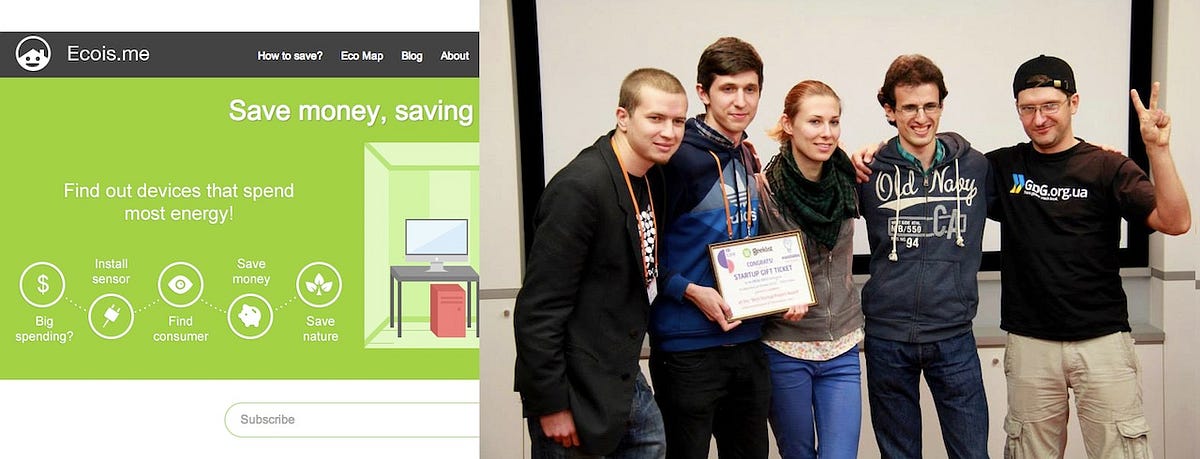
Ecois.me is founded by Alexander and Anton Diatlov, John Pasichnyk, and Nazar Mokrynskyi. All of the team members have a number of backgrounds from business to engineering. The team was involved with two projects before signing on to Ecois.me. One of the projects, opir.org, was an interactive map for monitoring situation during Ukrainian revolution with 800K views per first 24 hours of its work. Then it was rebuilt for monitoring election process in Ukraine. Also the team took part in developing of spilno.tv website, which uses Ustream platform to allow private individuals to create their own channels. At last count, it had over 23 million views.
How did they end up in Krakow?
Ecois.me came out of the Tesla Camp Hackathon in Ukraine and was part of Hubraum’s previous batch of Warp participants. They had received third prize which meant that Hubraum would stay in communication and help them develop their idea. The guys went back to Ukraine to work on their ideas until they got some interest from Dubai and an offer from Hubraum to come to Krakow. Within this time, they were also listed as one of the ‘smart energy’ startups in Tech.eu. They took the offer from Hubraum due to the fact that it was more funding and Deutsche Telekom offered better partnership possiblilties, branding, and the high quality mentorship. On top of that, Deutsche Telekom had a good relationship with major energy sector players.
The service
What Ecois.me have is a sensor which you install once at your flat inside the electricity panel. The sensor will transmit data to a cloud where it is analyzed. The data would be displayed on a web-based portal and mobile apps. It would display how your energy is used and when or where is it used the most. It will make recommendations to help you cut down on wasted energy. As a result, you would save on your energy costs. There could even be some rewards to gamify the saving process.
Currently, Ecois.me is in communication with the Open Interconnect Consortium to be part of their offerings. This consortium includes Samsung, Intel and Nest. They feel that their system can be compatible with the hardware and service represented by its members. They also feel that they are able to provide added value to the energy customer.
They are looking for firms and other partnership opportunities as well as some future investment partners. They are convinced that they are able to scale their product and service to other European as well as American markets. They will be participating in the next edition of Hack4good to be held in Hubraum between September 12 to 14, 2014. It starts at 6:00pm. This edition will be to hack against climate change, building projects and prototypes of technology solutions that address 15 global climate change challenges.
Thank you for reading another one of my posts done just for you! If you liked what you read please share it by using one of the buttons up top and check out other posts in this blog. I don’t want you to miss out on future posts so please follow me on Twitter @Eurodude23. If you haven’t done it already, please like my fan page by clicking here! See you next time!
Monday, September 8, 2014
iBeacons aren't just for big Retail
By Paul Chen
Thank you for reading another one of my posts done just for you! If you liked what you read please share it by using one of the buttons up top and check out other posts in this blog. I don’t want you to miss out on future posts so please follow me on Twitter @Eurodude23. If you haven’t done it already, please like my fan page by clicking here! See you next time!
Demystifying the iBeacons for SME's
So you have probably heard a lot about the iBeacon for a while now. And the Internet of Things will be taking over the world and enhance how we live our lives. TechCrunch recently labeled Krakow as some sort of Beacon Valley. Here we have Estimote and Kontakt.io. Both Estimote and Kontakt.io would like to boast about their big clients like Virgin Atlantic in Heathrow, Toronto's Eaton Centre, the Gap, and Siemens. Recently, there have been a lot of press about Estimote's Sticker Dev kit and Kontakt.io's Cloud Beacon. However, do you know that you can implement your own beacon customer service strategy? Costs start at just under $100. This guide will be your cheat sheet in implementing iBeacons in your small to medium retail establishment. Just be warned that you might not be able to implement it overnight. Some time will be needed, anywhere from a week to a month.
Let's get Started
First thing you have to do is to decide how you want to interact with your customers.
Do you want to just tell them about the products you have or some special sales? Do you want them to have the option of ordering or paying using their mobile devices? Do you want to keep track of how they move around the store so you can plan your store layout more effectively? Do you want them to be able to order food using their mobile device? These are some questions you must answer before you do anything else.
For some inspiration, watch the video below:
As you see the beacon is a device that pushes notifications to someone's mobile device be it a smartphone or a tablet and pretty soon a smartwatch. The beacon does not have all the content inside the small module. It simply sends out a Bluetooth signal to a smart device to display a certain piece of content. This piece of content can be information or it can be some sort of advert. It can be as simple as a picture or up to a whole mobile webpage with all the interactive elements.
Order the Estimote Beacon dev kit
The options on how to actually implement can be budget dependent. If your budget is limited, then you will have to find a tech savvy friend who is generous with his or her time. If you are lucky enough to have such a friend then all you need to do is to order a certain number of sets of beacons depending on your requirements. If you don't have a friend like that you will need to hire or outsource a developer to help you. You can find one locally through search engines like Google then order your beacons. If you have a small store one set may be enough. Bigger stores may need more than one set. You may not order beacons individually. A set of the developer's kit contains three (3) beacons. You may order Estimote beacons here.
Okay, so I have my beacons, now what?
After your get your beacons, you will need to create an app for your store. There are different ways you can create the app. There are three options: 1. You can hire a developer. 2. You can integrate your beacons with Apple's Passbook. 3. You can subscribe to a ready app. Passbook can be quite easy to use and more and more developers offer an app subscription option for small retails. Apple's Passbook is recommended due to the fact that it is already compatible with Estimote's beacons and is native for iPhones.
For the beacons to work, your developer will need to use Estimote’s SDK. In layman's terms, the SDK helps the devices determine what happens when they interact with softwares. Note that using other beacon SDK, you won’t have access to some of Estimote Beacons features like using built-in accelerometer or temperature sensor.
You will need to work with your developer to decide how the app will work and how it will look. The Passbook will guide you through the process. Once the app is ready and after a few successful tests have been done, you are ready to go.
How do you manage the beacons?
The current batch of beacons use the Bluetooth Smart (Bluetooth Low Energy) 4.0. It means the use of the battery is quite low. One cell size battery will last for about 2 years depending how often you push your content. The drain on your smart device is minimal. The thing that will eat up all your battery is the internet be it 3G or Wifi. Additionally, you will need to give each beacon a task to do. Remember, context is really important. These tasks can range from displaying an ad to allowing the customer to settle his or her bill through a payment service. Currently, Estimote is working with Canada’s nTrust.
And the content?
To change the content pushed by the beacon, you will need to change the content via cloud solution. New content will be updated within 30 seconds in the background while in WiFi or cell network range. If content is hardcoded in the app, an AppStore update might be necessary. For example a new function that you need an app upgrade could be the ability to pay using the smart device and new info pushed from the cloud might be this week's specials. Contents and functions can be changed via the editor's panel in Passbook or getting your developer friend to do the changes.
If you have any more questions, you may contact your beacon provider's community managers.Thank you for reading another one of my posts done just for you! If you liked what you read please share it by using one of the buttons up top and check out other posts in this blog. I don’t want you to miss out on future posts so please follow me on Twitter @Eurodude23. If you haven’t done it already, please like my fan page by clicking here! See you next time!
Thursday, September 4, 2014
Innovators’ Summit II conference – the exceptional meeting of innovators in business.
Joanna
Sawicka
13th September 2014, ul. Konarskiego 18C, Gliwice,
Poland
The Change Leaders Foundations organizes the second
edition of Innovators’ Summit Conference.
13th September 2014 in Technopark-Gliwice innovators,
entrepreneurs, managers, psychologists, trainers and leaders will gather to
debate on the question of how to bring innovations into business.
The main idea of the conference is to create a space
to exchange ideas, build a welcoming environment to establish new relations and
to enhance awareness of the significance of the
innovations in business.
The conference consists of two parts: the workshop
part and the Open Space Technology part.
During the workshop part participants can choose
between three workshops:
The leadership within the organization - the role and
competencies of the leader – Barbara CiemaÅ‚a
Effective leader tool kit – Izabela Åšmieja
Creative thinking in business – Natalia
Marek
At the same time, 10
special guests – entrepreneuers, innovators, directors, and company leaders
will be discussing about new trends in business and actions which entrepreneurs
and leaders should take to make valuable changes in world.
Second part of
conference is an experience in unique Open Space Technology which creates a
space for creativity to flow freely and for people to exchange their ideas,
thoughts and wisdom.
Building community of
change leaders, support innovations and spreading the idea of creating
supportive environment of world-changing business – this is the meaning, not
only of the conference, but also of the Change Leaders Foundation and people
who are creating it together.
We invite You to take
part in Innovators’ Summit Conference in Gliwice to build community of Change
Leaders with us.
If You want to take part in Innovators’ Summit
Conference in Gliwice you can register using this form:
Diversity is our greatest opportunity.
Change Leaders Foundation
Thank you for reading another one of my posts done just for you! If you liked what you read please share it by using one of the buttons up top and check out other posts in this blog. I don’t want you to miss out on future posts so please follow me on Twitter @Eurodude23. If you haven’t done it already, please like my fan page by clicking here! See you next time!
Wednesday, September 3, 2014
From Inspiration to Implementation
Tina Seelig : Professor of the Practice in the Department of Management Science and Engineering at Stanford University School of Engineering, and Executive Director of the Stanford Technology Ventures Program.
There is an insatiable demand for innovation and entrepreneurship. These skills are required to help individuals and ventures thrive in a competitive and dynamic marketplace. However, many people don’t know where to start. There isn’t a well-charted course from inspiration to implementation.
Other fields — such as physics, biology, math, and music — have a huge advantage when it comes to teaching those topics. They have clearly defined terms and a taxonomy of relationships that provide a structured approach for mastering these skills. That’s exactly what we need in entrepreneurship. Without it, there’s dogged belief that these skills can’t be taught or learned.
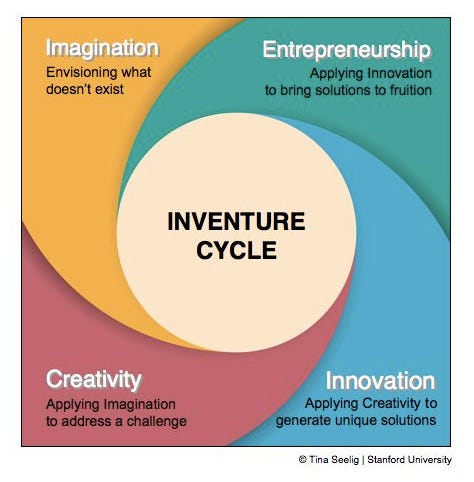
Below is a proposal for definitions and relationships for the process of bringing ideas to life, which I call the Inventure Cycle. This model provides a scaffolding of skills, beginning with imagination, leading to a collective increase in entrepreneurial activity.
INVENTURE CYCLE
Imagination is envisioning things that do not exist.
Creativity is applying imagination to address a challenge.
Innovation is applying creativity to generate unique solutions.
Entrepreneurship is applying innovation, bringing unique ideas to fruition, by inspiring others’ imagination.
This is a virtuous cycle: Entrepreneurs manifest their ideas by inspiring others’ imagination, including those who join the effort, fund the venture, and purchase the products. This model is relevant to startups and established firms, as well as innovators of all types where the realization of a new idea — whether a product, service, or work of art — results in a collective increase in imagination, creativity, and entrepreneurship.
This framework allows us to parse the pathway, describing the actions and attitudes required at each step along the way.
Imagination requires engagement and the ability to envision alternatives.
Creativity requires motivation and experimentation to address challenges.
Innovation requires focusing and reframing to generate unique solutions.
Entrepreneurship requires persistence and the ability to inspire others.
Not every person in an entrepreneurial venture needs to have every skill in the cycle. However, every venture needs to cover every base. Without imaginers who engage and envision, there aren’t compelling opportunities to address. Without creators who are motivated to experiment, routine problems don’t get solved. Without innovators who focus on challenging assumptions, there are no fresh ideas. And, without entrepreneurs who persistently inspire others, innovations sit on the shelf.
Let’s look at an example to see these principles at work:
As a Biodesign Innovation Fellow at Stanford University, Kate Rosenbluth spent months in the hospital shadowing neurologists and neurosurgeons in order to understand the biggest unmet needs of physicians and their patients.
In the imagination stage, Kate worked with a team of engineers and physicians to make lists of hundreds of problems that needed solving, from outpatient issues to surgical challenges. By being immersed in the hospital with a watchful eye, she was able to see opportunities for improvement that had been overlooked. This stage required engagement and envisioning.
In the creativity stage, the team was struck by how many people struggle with debilitating hand tremors that keep them from holding a coffee cup or buttoning a shirt. They learned that as many as six million people in the United States are stricken with Parkinson’s disease, and other conditions that cause tremors. The most effective treatment is deep brain stimulation, an onerous and expensive intervention that requires permanently implanting wires in the brain and a battery pack in the chest wall. Alternatively, patients can take drugs that often have disabling side effects. The team was driven to help these patients and began meeting with experts, combing the literature, and testing alternative treatments. This stage required motivation and experimentation.
In the innovation stage, Kate had an insight that changed the way that she thought about treating tremors. She challenged the assumption that the treatment had to focus on the root cause in the brain and instead focused on the peripheral nervous system in the hand, where the symptoms occur. She partnered with Stanford professor Scott Delp to develop and test a relatively inexpensive, noninvasive, and effective treatment. This stage required focus and reframing.
In the entrepreneurship stage, Kate recently launched a company, Cala Health, to develop and deliver new treatments for tremors. There will be innumerable challenges along the way to bringing the products to market, including hiring a team, getting FDA approval, raising subsequent rounds of funding, and manufacturing and marketing the device. These tasks require persistence and inspiring others.
While developing the first product, Kate has had additional insights, which have stimulated new ideas for treating other diseases with a similar approach, coming full circle to imagination!
This model underpins related frameworks for innovation and entrepreneurship, such as design thinking and the lean startup methodology. Both of these models focus on defining problems, generating solutions, building prototypes, and iterating on the ideas based on feedback. The Inventure Cycle describes foundational skills that are mandatory for those methods to work. Just as we must master arithmetic before we dive into algebra or calculus, it behooves us to develop an entrepreneurial mindset and methodology before we design products and launch ventures. By understanding the Inventure Cycle and honing the necessary skills, we identify more opportunities, challenge more assumptions, generate unique solutions, and bring more ideas to fruition.
With clear definitions and a taxonomy that illustrates their relationships, the Inventure Cycle defines the pathway from inspiration to implementation. This framework captures the skills, attitudes, and actions that are necessary to foster innovation and to bring breakthrough ideas to the world.
Thank you for reading another one of my posts done just for you! If you liked what you read please share it by using one of the buttons up top and check out other posts in this blog. I don’t want you to miss out on future posts so please follow me on Twitter @Eurodude23. If you haven’t done it already, please like my fan page by clicking here! See you next time!

This is a repost of an article that appeared on medium.com on September 2, 2014
There is an insatiable demand for innovation and entrepreneurship. These skills are required to help individuals and ventures thrive in a competitive and dynamic marketplace. However, many people don’t know where to start. There isn’t a well-charted course from inspiration to implementation.
Other fields — such as physics, biology, math, and music — have a huge advantage when it comes to teaching those topics. They have clearly defined terms and a taxonomy of relationships that provide a structured approach for mastering these skills. That’s exactly what we need in entrepreneurship. Without it, there’s dogged belief that these skills can’t be taught or learned.
Below is a proposal for definitions and relationships for the process of bringing ideas to life, which I call the Inventure Cycle. This model provides a scaffolding of skills, beginning with imagination, leading to a collective increase in entrepreneurial activity.
INVENTURE CYCLE
Imagination is envisioning things that do not exist.
Creativity is applying imagination to address a challenge.
Innovation is applying creativity to generate unique solutions.
Entrepreneurship is applying innovation, bringing unique ideas to fruition, by inspiring others’ imagination.
This is a virtuous cycle: Entrepreneurs manifest their ideas by inspiring others’ imagination, including those who join the effort, fund the venture, and purchase the products. This model is relevant to startups and established firms, as well as innovators of all types where the realization of a new idea — whether a product, service, or work of art — results in a collective increase in imagination, creativity, and entrepreneurship.
This framework allows us to parse the pathway, describing the actions and attitudes required at each step along the way.
Imagination requires engagement and the ability to envision alternatives.
Creativity requires motivation and experimentation to address challenges.
Innovation requires focusing and reframing to generate unique solutions.
Entrepreneurship requires persistence and the ability to inspire others.
Not every person in an entrepreneurial venture needs to have every skill in the cycle. However, every venture needs to cover every base. Without imaginers who engage and envision, there aren’t compelling opportunities to address. Without creators who are motivated to experiment, routine problems don’t get solved. Without innovators who focus on challenging assumptions, there are no fresh ideas. And, without entrepreneurs who persistently inspire others, innovations sit on the shelf.
Let’s look at an example to see these principles at work:
As a Biodesign Innovation Fellow at Stanford University, Kate Rosenbluth spent months in the hospital shadowing neurologists and neurosurgeons in order to understand the biggest unmet needs of physicians and their patients.
In the imagination stage, Kate worked with a team of engineers and physicians to make lists of hundreds of problems that needed solving, from outpatient issues to surgical challenges. By being immersed in the hospital with a watchful eye, she was able to see opportunities for improvement that had been overlooked. This stage required engagement and envisioning.
In the creativity stage, the team was struck by how many people struggle with debilitating hand tremors that keep them from holding a coffee cup or buttoning a shirt. They learned that as many as six million people in the United States are stricken with Parkinson’s disease, and other conditions that cause tremors. The most effective treatment is deep brain stimulation, an onerous and expensive intervention that requires permanently implanting wires in the brain and a battery pack in the chest wall. Alternatively, patients can take drugs that often have disabling side effects. The team was driven to help these patients and began meeting with experts, combing the literature, and testing alternative treatments. This stage required motivation and experimentation.
In the innovation stage, Kate had an insight that changed the way that she thought about treating tremors. She challenged the assumption that the treatment had to focus on the root cause in the brain and instead focused on the peripheral nervous system in the hand, where the symptoms occur. She partnered with Stanford professor Scott Delp to develop and test a relatively inexpensive, noninvasive, and effective treatment. This stage required focus and reframing.
In the entrepreneurship stage, Kate recently launched a company, Cala Health, to develop and deliver new treatments for tremors. There will be innumerable challenges along the way to bringing the products to market, including hiring a team, getting FDA approval, raising subsequent rounds of funding, and manufacturing and marketing the device. These tasks require persistence and inspiring others.
While developing the first product, Kate has had additional insights, which have stimulated new ideas for treating other diseases with a similar approach, coming full circle to imagination!
This model underpins related frameworks for innovation and entrepreneurship, such as design thinking and the lean startup methodology. Both of these models focus on defining problems, generating solutions, building prototypes, and iterating on the ideas based on feedback. The Inventure Cycle describes foundational skills that are mandatory for those methods to work. Just as we must master arithmetic before we dive into algebra or calculus, it behooves us to develop an entrepreneurial mindset and methodology before we design products and launch ventures. By understanding the Inventure Cycle and honing the necessary skills, we identify more opportunities, challenge more assumptions, generate unique solutions, and bring more ideas to fruition.
With clear definitions and a taxonomy that illustrates their relationships, the Inventure Cycle defines the pathway from inspiration to implementation. This framework captures the skills, attitudes, and actions that are necessary to foster innovation and to bring breakthrough ideas to the world.
Thank you for reading another one of my posts done just for you! If you liked what you read please share it by using one of the buttons up top and check out other posts in this blog. I don’t want you to miss out on future posts so please follow me on Twitter @Eurodude23. If you haven’t done it already, please like my fan page by clicking here! See you next time!
This is a repost of an article that appeared on medium.com on September 2, 2014
Tuesday, September 2, 2014
Everything You Need to Know About the Mobile Market in Poland
Adrian Senecki
In 2012 the smartphone market in Poland seemed to slow down and started showing the first signs of saturation. This is no longer the case according to the latest MEC Mobile Report. Today as many as 61 percent of Internet users in Poland possess such devices and over one fourth say they couldn’t imagine their lives without them.
According to the latest MEC Mobile Report, which came out at the end of last month, the mobile market in Poland is still prolific, but only within the current consumer base.
In 2012 the smartphone market in Poland seemed to slow down and started showing the first signs of saturation. This is no longer the case according to the latest MEC Mobile Report. Today as many as 61 percent of Internet users in Poland possess such devices and over one fourth say they couldn’t imagine their lives without them.
The percentage of smartphone owners among Polish Internet users grew by 17% since 2013 – from 53 to 61%.
Such
mobile devices are the most popular among the youngest users analyzed
– aged 15-19 years old – whose demographic boasts 78% smartphone
users. What’s more interesting, however, is that those aged 45-49
had the biggest leap in popularity – a 45% growth in the usage of
such devices lifted the percentage of Internet enabled 40-year-olds
to 57%. The elderly, or those over 59 years old, also picked up their
phones at last, reporting an increase from 22 to 39%.
Indispensable
As
smartphones gradually become more and more widespread, their role in
our lives changes. As many as 27 percent of the users, a 5% increase
compared to the previous year, just can’t seem to live without them
anymore.
Poles
find the mobile Internet increasingly fit for communication with
their friends – through Facebook (46%) or by email (41%). The
former is a lot more popular among women (close to 60 percent, while
only 31% of males follow suit). As for group ages, the mobile
Internet is by far the most popular among youth aged 15-19 (over 76%
connect to Facebook on their mobile devices).
Do
we use our phones for work?
Unfortunately,
the usage of Internet-enabled phones for business purposes is still
rare enough to justify complaints. Only 13 percent of users benefit
from their potential to rapidly deal with financial transactions.
Mobile shopping is an issue only of concern of just around four
percent of users. While the financial issue shows promise, and 13
percent is still a decent improvement over 9% two years ago, mobile
shopping hasn’t grown at all over the last two years.
Increasingly,
more and more smartphone users are choosing to install extra apps –
72% of them do so at least every once in a while, which is five
percent more than a year ago. The vast majority of users, however,
don’t have more that 10 extra apps on their devices.
Price
is an issue of utmost importance for smartphone users in Poland.
That’s why free apps are the prime choice for most.
When faced with an alternative – a paid app without ads or a free one supported by advertising – Poles are a lot more likely to choose the latter.
Only
17 percent of users download both paid and free apps and,
significantly, the percentage of those who pay for apps has decreased
slightly over the past 24 months.
“Marketers
are likely to welcome the permissive approach of consumers towards
advertising. As many as 55 percent of smartphone users claim to have
come across such ads on their devices. More users than ever, now
around 40%, admit to searching for further information on brands due
to mobile advertising. Over two thirds of the entire consumer group
now have access to the mobile Internet and use it increasingly more
often. Therefore the big question is not if, but how to make your
brand visible on this platform,” says MEC Poland’s CEO Izabela
Albrychiewicz.
Just
how popular are mobile websites?
But
is it worth targeting mobile websites with advertising campaigns in
Poland? Last year’s interaktywnie.com report titled
“Mobile Marketing” has some clues on that issue. According to
this research, as many as 38 percent of smartphone users do choose
mobile websites over the full desktop version. However, the full
version display, which is difficult to handle on a small smartphone,
enjoys a strong 25 percent popularity.
Tablet
mobile usage brings a lot less positive news – over half of all
Polish users go for the desktop version of a website and only one
fifth choose the mobile. When targeting a campaign through Facebook,
for example, it’s worth distinguishing not only between the desktop
and mobile versions, but between smartphones and tablets as well.
It’s not easy, but Facebook’s Power Editor allows for choosing
particular devices, like the iPad or Samsung Galaxy Tab, to be
targeted.
The
MEC survey shows that there is still a lot of room for growth in the
smartphone market, but mostly within the current user base. Among
those who have owned their mobile devices for at least the last six
months, almost 50% are seriously considering replacing their devices.
At the same time, only 13 percent of those who don’t have such a
device are pondering a change.
Thank you for reading another one of my posts done just for you! If you liked what you read please share it by using one of the buttons up top and check out other posts in this blog. I don’t want you to miss out on future posts so please follow me on Twitter @Eurodude23. If you haven’t done it already, please like my fan page by clicking here! See you next time!
This is a repost of an article that appeared on bitspiration.com on September 1, 2014.Thank you for reading another one of my posts done just for you! If you liked what you read please share it by using one of the buttons up top and check out other posts in this blog. I don’t want you to miss out on future posts so please follow me on Twitter @Eurodude23. If you haven’t done it already, please like my fan page by clicking here! See you next time!
Monday, September 1, 2014
Thoughts of a Lean Startup Practitioner
Paul Chen
Last week at AIPBusiness Link in Krakow, Ian Scarffe gave an introductory lecture and
workshop about how to use lean startup model as evangelised by Steve
Blank, Bob Dorf and Eric Ries. He explained the general idea of Lean
Startup and how to get out of the building and conduct proper
customer discovery. Ian is a serial entrepreneur, who is now living
in Krakow. Ian is one of the leaders and believers in the Krakow
Startup Community. I had a chance to sit down to chat with Ian about
his experiences and what he thinks would help the community reach new
levels.
Hello Ian, that
was an intriguing talk. How do you feel about the feedback of the
audience?
We had a limited
number of seats available for the workshop, and to see the room
overflow was a nice sign, it proves that there are a lot of people
wanting to learn more about Lean Startup process and what I refer to
as Lean Business Development. It is also good to know that companies
like Business Link are getting behind the lean startup movement.
There were some
nice ideas presented, which one did you feel has the most promise?
I am working with
some of the participants now, helping them to conduct the first phase
of customer discovery and to confirm what ideas are worth
investigating more. The most promising idea was a “uber” style of
business for physical things.
Is there any
concept that you feel the audience isn't really understanding yet?
One thing that needs
to be clear is that startup enthusiasts need to understand the
concept of “getting out of the building” and gaining quality
feedback from potential customers, moreover, that the process is not
a one time event, it is a continuous process; as you confirm your
first hypothesis, you may need to change direction or the model
somewhat and then you need to “get out of the building” and
recheck the new version with a new set of potential customers, and so
on and so forth.
How did you get
into the practice of lean startup?
Having years of
experience as an entrepreneur teaches you many lessons, some of them
are you are able to learn along the way and some of them you are
forced to learn. I have had some terrible failures along the way, as
do most entrepreneurs, and it was due to the failures that I learned
to work on the ideas that fit with the market demands, hence the
meaning of product market fit, an integral part of lean startup.
What process in
Lean Startup is the most appealing to you?
I have always had a
passion for customer service, and if you understand what makes good
customer relations you then can understand what you need to do to
deliver a unique product and or service to the customer or end user.
This is all part of lean startup, discovering your customers and then
delivering the desired product or service. This is one aspect of lean
startup that is both exciting and rewarding.
Some people think
that lean startup is about being cheap, how do you dispel that
notion?
Lean Startup is not
about being cheap; it has nothing to do with money, in general it is
all about using all of your resources wisely. Lean Startup methods
teach you to work smarter, not harder. I believe it also helps you
qualify your ideas at a very early stage without having to burn you
cash. Why would anyone want to build a whole new business, company
setup, website, logo, office, etc without having first proven if the
idea is worth investing resources in!
You were quite
involved in the Global Student Entrepreneur Awards Poland, please
tell us more about that?
Last year we ran the
Global Student Entrepreneur Awards for the first time in Poland and
it was a huge success. Natalia Maczek, from Misbhv was awarded the
best Polish student entrepreneur, and she well deserves it. We flew
her to Washington, USA to compete with other student entrepreneurs
from all over the globe. Natalia’s passion and experience in
business helped her to be awarded by the judges with the Lessons from
the Edge Award.
You also run
Binkplus.pl, an incubator. Please, tell us more about it.
I established
Binkplus.pl a few years ago to help young entrepreneurs who have
ideas to turn them into early stage startups. I had been mentoring
and consulting in the startup industry for many years and this was a
natural progress of formalizing the process and to incorporate lean
startup principals into the mix. Binkplus also acts as a bridge
between Polish startups and the global community of early stage
investors and the startup community as a whole.
Who have you
helped grow with Binkplus.pl?
A few years ago at
one of the first Hive53 meetings, I saw Damian Sluja, pitch his idea
for a student based social network. I liked the idea and after a few
meetings we decided to move from the idea stage to developing the
portal Baseconnect.org, all using Lean Startup methods into a global
network of student and graduates. Today Baseconnect.org has the
support of some of the largest student organizations in the world,
and international companies such as IBM, Heineken, Cap Gemini, and
Lufthansa, to name a few.
How do you feel
about the Polish startup community?
The Polish startup
scene is still quite young and we still need to work together to
build and connect the communities. We also need to educate and inform
young entrepreneurs and startup enthusiasts
that
becoming entrepreneurs can be a life changing decision, and a lot of
hard work. If we want to make a difference in the world we have to
take risk, no risk no gain. However, it can also be fun becoming the
next Steve Jobs or Mark Zuckerberg.
What do you feel
are two thing that would help to get the Polish startup community to
the next level?
At the moment I am
in talks with Techstars, who is the number one startup accelerator in
the world and we are looking to introduce a similar program into
Poland. This would help to build bridges between other startup
communities across the globe with Poland.
We also need to have
the support of the government and local business to further enhance
the awareness and support the community, be it with resources and or
financial support.
The overall mission
of everyone should be to foster a society of economically independent
individuals who are engaged citizens, contributing to the improvement
of their communities.
Thanks
for talking to us. We are looking forward to more from you in the
future.
Thank you for reading another one of my posts done just for you! If you liked what you read please share it by using one of the buttons up top and check out other posts in this blog. I don’t want you to miss out on future posts so please follow me on Twitter @Eurodude23. If you haven’t done it already, please like my fan page by clicking here! See you next time!
Subscribe to:
Posts (Atom)